Is SEO Dead? No, But the SEO You Learned in 2015 Is
The rumor that won't die
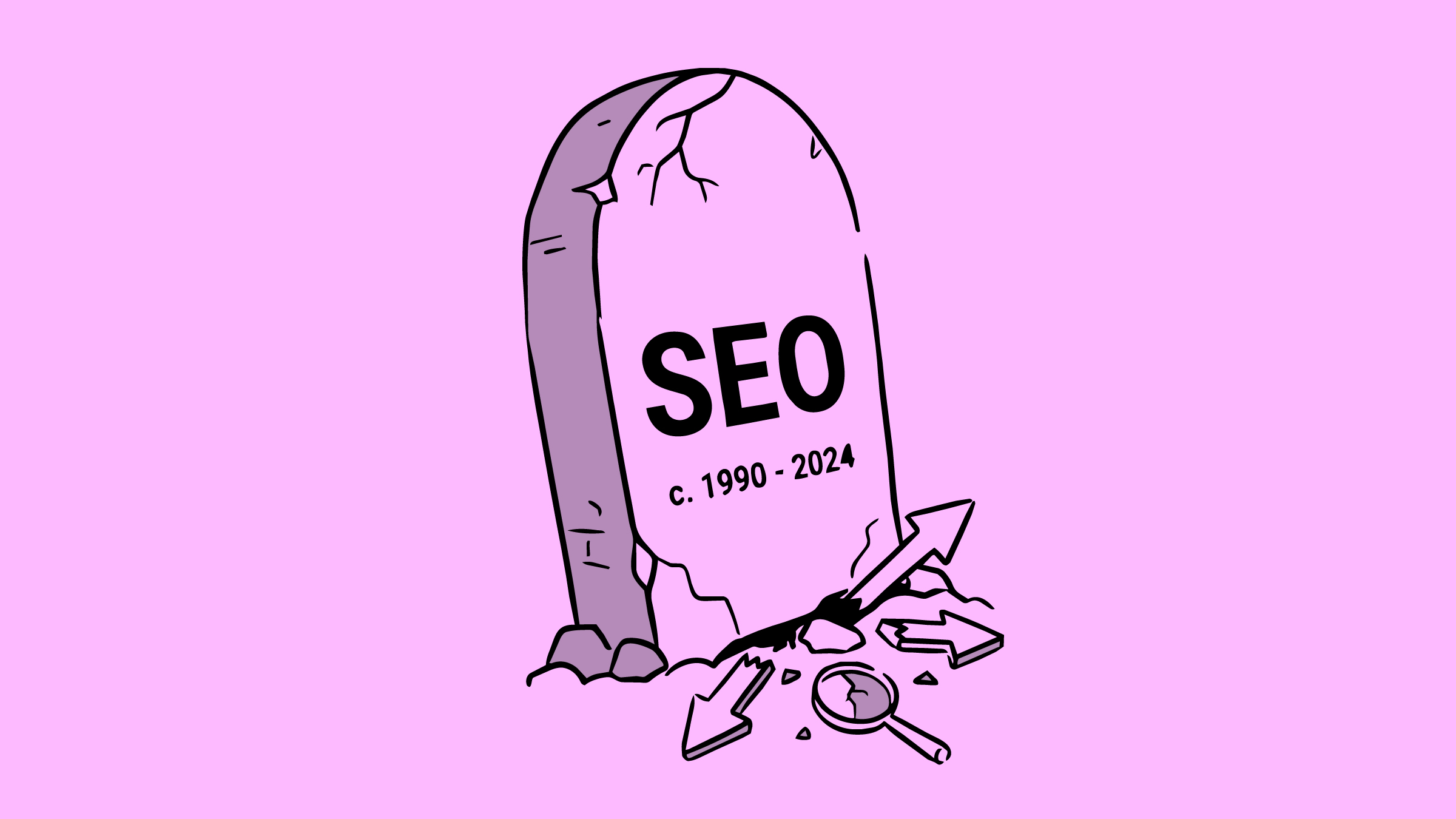
No, SEO isn't dead. But it changed enough that the people declaring its death have a point buried under the hype.
"SEO is dead" gets announced after every big Google update, and it's been wrong every time for fifteen years. What's different now is that something real did shift. Search stopped being a list of ten blue links and turned into an answer engine.
Your customers now ask ChatGPT for a shortlist, skim a Google AI Overview, check reviews on the map, look you up on LinkedIn, and then maybe visit your site. By the time they land on your page, they've already decided whether you seem credible.
That isn't the death of SEO. It's SEO spreading into places that didn't exist five years ago.
Where the "SEO is dead" idea comes from
The claim isn't made up. Three real shifts feed it.
Zero-click search became the default
Nearly 60% of US Google searches now end without a click to any outside website. SparkToro and Datos found that out of every 1,000 US Google searches, only around 360 lead to a click on the open web, and zero-click rates have climbed since as AI Overviews spread. Pew Research found that when an AI Overview shows up, people click a link inside it only about 1% of the time.
If your definition of SEO success is "sessions in Google Analytics," that looks like a funeral.
AI Overviews changed what "ranking" means
Ranking first used to mean you got the click. Now the top result sits below a generated summary that may have already answered the question. Ahrefs found that AI Overviews can sharply cut the click-through rate for the top organic result on the queries where they appear, and Seer Interactive found the biggest drops on simple informational searches: the "what is," "how much does it cost," and "how long does it take" questions that so many company blogs are built on.
The buyer's journey moved off your website
This is the shift that matters most, and the one people discuss least. Research that used to happen on your site now happens somewhere else: an AI summary, a comparison thread, a review site, a Reddit answer, a directory listing.
You didn't lose the customer. You lost sight of the middle of their journey. Those are very different problems, and only one of them is fatal.
What SEO actually became
A more useful way to look at it: SEO didn't die, the sequence changed.
The old model was a straight line: rank, click, lead. The new one is spread out: be understood, be trusted, be cited, be chosen. You can shape every step of that. You just can't measure it with one traffic number anymore.
From keywords to intent
Search engines read meaning now, not just matching words. A page that repeats "commercial HVAC repair Phoenix" fourteen times does worse than one that clearly explains what you fix, what it costs, how fast you respond, who you've done it for, and how to get started.
People also search in fragments: problems, symptoms, competitor names, "near me," "vs," "alternative to," "pricing." Good content covers a whole line of questions, not one search. Ask what someone wonders about ten seconds after the AI Overview answers their first question, then answer that too.
From rankings to showing up in more places
You now need to appear in several places at once:
- Regular search results
- Google AI Overviews and AI Mode
- Google's local map results and your Google Business Profile
- ChatGPT, Perplexity, Copilot, and other assistants
- Marketplaces, directories, and review sites your buyers trust
- Communities and other sites where your industry gets discussed
The industry has coined names for optimizing toward AI answers, like GEO and AEO. Underneath the labels, the goal is old-fashioned: make it easy for a machine to understand who you are, what you do, who you serve, and why you're credible.
From volume to trust
Google, and now AI systems, increasingly judge content by experience, expertise, authority, and trust. That has become the filter AI uses to decide who's worth citing.
In practice, that means named authors with real credentials instead of "admin." Original data, case studies, and specifics instead of reworded common knowledge. The same facts about your business everywhere it's mentioned. Mass-produced AI content is a liability now. A page only your company could have written is an asset.
How to get the most from SEO today
Practical moves, roughly in order of payoff.
1. Answer real questions in plain language
Build your service and product pages like a guided conversation: what this is, who it's for, how it works, what it costs, what to expect, how to start. Short paragraphs. Direct answers near the top. FAQ sections that match how people actually ask.
This is the format that gets pulled into AI answers and featured snippets, and it's a better experience for a distracted person on a phone either way.
2. Make your credibility easy for a machine to read
- Real author bios with credentials, linked to their profiles elsewhere
- Named case studies, client logos, and results with numbers
- Structured data (also called schema) that labels your business, locations, products, services, and FAQs
- The same name, address, phone, and description on every site that lists you
If a machine can't confirm who stands behind your claims, it has no reason to cite you over a competitor it can confirm.
3. Get mentioned on sites you don't control
AI systems build their picture of you from the whole web, not just your homepage. Industry publications, podcasts, directories, review sites, partner pages, and comparison articles are now part of how you get ranked and cited.
The old name for this was PR. It's the most underrated SEO channel going right now.
4. Fix the technical foundation
Fast mobile pages. One clear main heading, with the rest organized under it in order. Descriptive links. Labeled forms. Logical navigation. Content a search engine can actually read, not buried in code it can't. A sitemap that matches your real site.
None of this is exciting, and all of it adds up.
5. Measure visibility, not just sessions
Update your dashboard for the world you're actually in:
- Impressions for your priority topics in Search Console
- Whether you're cited in AI Overviews, ChatGPT, and Perplexity for your core questions
- Google Business Profile actions: calls, direction requests, form fills
- Conversions from organic and local search
- Branded search volume, the truest sign your visibility is working
Traffic can fall while revenue rises. That isn't failure. It's the new shape of success. Some studies even find that the clicks surviving an AI Overview convert better, because the low-intent browsers got filtered out before they reached you.
The priorities change with your size
The principles are the same for everyone. The priorities aren't.
Small and mid-sized businesses: win narrow
You won't out-publish a big competitor, and you shouldn't try. Your edge is being specific and fast.
- Go deep on a small set of pages that map to how you actually make money, and make them the best pages on the internet for those exact questions
- Treat your Google Business Profile as a main asset, not an afterthought. Hours, photos, services, and reviews move the needle fast
- Publish what only you can: real project photos, real pricing ranges, real answers your team gives on the phone every week
- Put a name and a face on your content. A real person is easier to trust than an anonymous brand
- Don't chase high-volume informational keywords that AI now answers for free
Mid-market and enterprise: win on structure
Your problem is rarely how much content you have. It's that ten thousand pages of it are inconsistent, duplicated, unowned, and slowly rotting.
- Take stock of all your content and consolidate or retire it aggressively. Thin and duplicate pages work against you
- Build real depth on a subject with a group of related pages, instead of one-off posts chasing keywords
- Get internal linking and site structure right. At scale, that's worth more than any single page
- Add structured data through templates, not page by page
- Fix the cross-team friction. SEO now depends on engineering, legal, PR, product, and brand working together, and that coordination is usually the real bottleneck
- Standardize your location and product page templates so every one has real substance, not just a city name dropped into a template
Where accessibility and SEO overlap
Here's something we find in nearly every audit at Semmodo: the sites that struggle in search are usually the same ones that fail accessibility testing. That's no coincidence.
They need the same things
Screen readers and search crawlers both read your site as structure, not as visual design. Both need:
- One clear, meaningful main heading and a sensible heading order
- Descriptive link text instead of "click here"
- Alt text that actually describes the image
- Properly labeled form fields
- Enough contrast, and text that stays readable when zoomed
- Menus, filters, and checkout steps you can use with a keyboard
Fix these once and you improve two things at the same time: how people with disabilities experience your business, and how machines understand it.
The business case runs both ways
Web accessibility lawsuits and demand letters have become routine in retail, hospitality, finance, healthcare, and professional services, and most companies get no warning before one lands. That's the risk side.
The growth side is quieter but bigger. A checkout, booking form, or contact page someone can't use is a place you lose customers. People who can't use your site don't complain. They leave, and they never show up in your analytics as a lost sale. You paid to bring them there either way.
What genuinely doesn't work anymore
To be fair to the "SEO is dead" crowd, plenty of tactics have earned their obituary:
- Publishing thin, AI-generated articles by the dozen
- Writing for keyword density instead of for customers
- Buying links and expecting authority
- Duplicate location or product pages with the name swapped out
- Treating your website as a brochure you update every three years
- Judging the whole program on raw organic sessions
If that's what someone means by SEO, then sure, it's dead, and good riddance.
The bottom line
SEO didn't die. It grew up, and got harder to fake.
The businesses winning in search right now aren't the ones with the cleverest keyword strategy. They're the ones with a fast, accessible, well-structured website, clear plain-language answers to what customers actually ask, visible proof of expertise, and a steady presence across the places where their industry gets discussed. That's not a trick. It's being genuinely findable and genuinely trustworthy, which is what search engines have spent two decades slowly trying to reward.
The good news: your competitors are mostly still arguing about whether SEO is dead instead of fixing their heading structure.
Frequently asked questions
Is SEO dead?
No. Search turned from a list of links into an answer engine, so SEO now means being visible across AI answers, maps, reviews, and search, not just ranking for clicks. The old tricks died, but being genuinely findable and trustworthy matters more than ever.
Why is my website getting less traffic from Google?
Because more searches end without a click. AI Overviews and other on-page answers handle the question before anyone leaves Google. Nearly 60% of US Google searches now end with no click to an outside site (SparkToro and Datos, 2024).
What are GEO and AEO?
They're new names for optimizing so AI answer engines understand and cite you. The goal underneath is the same as always: make it easy for a machine to understand who you are, what you do, and why you're credible.
How do I show up in AI answers like ChatGPT and Google AI Overviews?
Answer real questions in plain language, prove your credibility with named authors, case studies, consistent business details, and schema, and get mentioned on sites AI trusts, like industry publications, directories, and review platforms.
Does accessibility affect SEO?
Yes. Screen readers and search crawlers both read your site as structure. Clean headings, descriptive links, alt text, and labeled forms help disabled visitors and machines at the same time.
How do I measure SEO now that traffic is falling?
Track visibility, not just sessions. Watch your impressions for key topics, whether you're cited in AI answers, your Google Business Profile calls and direction requests, conversions from organic and local search, and your branded search volume.
Ready to find out where your site actually stands? Semmodo audits websites for accessibility, structure, and technical health, the foundation everything else in search is built on. Schedule a free consultation.